Last updated: May 2026 · 2026 current
Most Homeowners Don't Need a Panel Upgrade
The majority of homes built after 1990 with 200A electrical service have sufficient capacity to add a Level 2 EV charger without a panel upgrade. The key question isn't the size of your service — it's how much of it is already being used on a continuous basis.
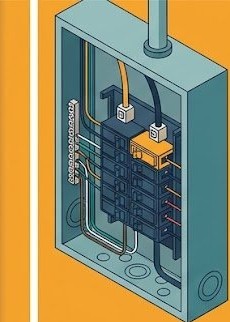
Step 1: Find Your Service Size
Your service size is the total amperage your home's electrical service can deliver. It's printed on the main breaker at the top of your electrical panel — the large double-pole breaker that controls everything. Common residential service sizes:
- 100A service: Common in homes built before 1980. Usually sufficient for the home itself, but adding a 50A EV circuit may require load analysis or upgrade.
- 150A service: Less common; found in some 1970s–1990s homes. Usually adequate for EV charging with proper load analysis.
- 200A service: Standard for homes built after approximately 1985. Almost always sufficient for a Level 2 EV charger if the home doesn't have unusual electrical loads.
- 400A service: Found in larger homes or those with electric heating, pools, or multiple HVAC systems. More than adequate.
Step 2: Calculate Your Existing Load
Service size alone doesn't tell you whether you have capacity — you need to know how much of that capacity is already spoken for. Add up the amperage of your major circuits:
- HVAC system (check the nameplate on the unit — typically 20–60A depending on size)
- Electric water heater (typically 30A if electric)
- Electric dryer (typically 30A)
- Electric range/oven (typically 40–50A)
- Major appliances: dishwasher (20A), refrigerator (20A), washer (20A)
- Lighting and general outlets (add up the breakers — typically 15A or 20A each)
Then apply the NEC continuous load rule: your total installed load should not exceed 80% of your service size for safety (the 80% rule allows headroom for simultaneous loads). A 200A service should not have more than 160A of continuous load installed.
Example Calculation
200A service home. Installed loads: 5-ton HVAC (50A) + electric water heater (30A) + electric dryer (30A) + lighting/outlets (~40A) + appliances (~20A) = ~170A total installed. The 80% rule suggests keeping total continuous load under 160A. Adding a 50A EV circuit would bring you to 220A — over the panel's 200A rating. In this scenario, a panel upgrade or load management system would be warranted.
Step 3: Count Available Breaker Slots
Even if you have electrical capacity, you need physical space in the panel for a new double-pole breaker. A 50A Level 2 EV circuit requires a 50A double-pole breaker, which occupies two adjacent slots.
Look in your panel for open (empty) breaker slots. If there are two adjacent open slots, you have physical space. If the panel is completely full, options include:
- Tandem breakers: If your panel supports them (listed on the panel label), some single-pole breakers can be replaced with tandem (dual) breakers that fit two circuits in one slot, freeing up space.
- Subpanel: Install a small subpanel fed from the main panel to create additional circuit capacity. This is often less expensive than a full service upgrade.
- Full panel upgrade: Replace the existing panel with a larger one (e.g., 200A → 200A with more slots, or 100A → 200A).
When a Panel Upgrade Is Actually Needed
A panel upgrade (service upgrade) is a separate, larger project from the EV charger installation. You'll definitely need one if:
- Your service is 60A or less (very old homes — upgrade is needed for safety regardless of the EV charger)
- Your load calculation shows existing continuous loads already exceed 80% of service capacity
- Your panel has no available breaker slots and tandem breakers are not supported
- Your panel brand is Zinsco, Pushmatic, or Federal Pacific Stab-Lok (known safety issues — independent of EV charging)
- Your utility only delivers 100A service to your meter (a panel upgrade alone won't help — you'd need utility coordination)
Alternatives to a Full Panel Upgrade
A full service panel upgrade typically costs $2,000–$5,000 and requires utility coordination. Before committing to one, consider:
- Smart load management: Some EV chargers (and third-party load management devices like the Emporia Load Management System or Leviton Load Management) monitor your total panel load in real time and reduce EV charging speed when other large loads come on. This can allow EV charging on a 100A service that would otherwise be borderline.
- Smaller charger circuit: Instead of a 50A circuit (40A charger), install a 40A circuit (32A charger). This reduces the circuit load by 20% and may provide enough headroom without a panel upgrade while still delivering adequate charging speed (25+ miles of range per hour).
- Time-of-use charging: Most EVs can be programmed to charge only during off-peak hours (overnight when HVAC and other large loads are minimal). This reduces simultaneous load even if the installed capacity is high.
Panel Upgrade Permit Requirements
A service panel upgrade is a separate permit from the EV charger permit in most jurisdictions. Panel upgrades typically require:
- A separate electrical permit for the panel work
- Utility coordination — the utility must disconnect and reconnect service, which requires scheduling separately
- A separate inspection for the panel work
- Potentially a separate permit and inspection for the new service entrance if conduit or wiring is modified
Budget 2–6 weeks for the full panel upgrade process including utility scheduling, which is often the longest variable in the timeline.
ChargePoint HomeFlex Level 2 EV Charger (J1772)
If you're going through the permit process anyway, it's worth getting a charger that's rated for up to 50 amps — giving you 25+ miles of range per hour on almost any EV. The ChargePoint Home Flex is adjustable from 16A to 50A, works with any EV brand, qualifies for many utility rebates, and is one of the most commonly installed residential chargers in the U.S. UL listed, indoor/outdoor rated, and widely stocked at major retailers.
- ✓ Adjustable 16A–50A output — works with any panel capacity
- ✓ Compatible with every EV brand (J1772; Tesla with adapter)
- ✓ 23-ft cable — reaches most garage parking positions
- ✓ Indoor & outdoor rated, hardwire or plug-in options
- ✓ Qualifies for many utility rebate programs
- ✓ UL listed — #1 best-seller, 4.3★ from 2,200+ reviews
As an Amazon Associate, EV Charger Permit Hub earns from qualifying purchases. Affiliate links support this free resource at no additional cost to you.
View on Amazon → ($549, Prime eligible)Frequently Asked Questions
Informational Only
This guide provides general guidance on electrical panel capacity. A licensed electrician should perform a load calculation specific to your home before any conclusions about panel upgrade necessity. This is not professional electrical advice.